Redefining Heroism in the Age of AGI
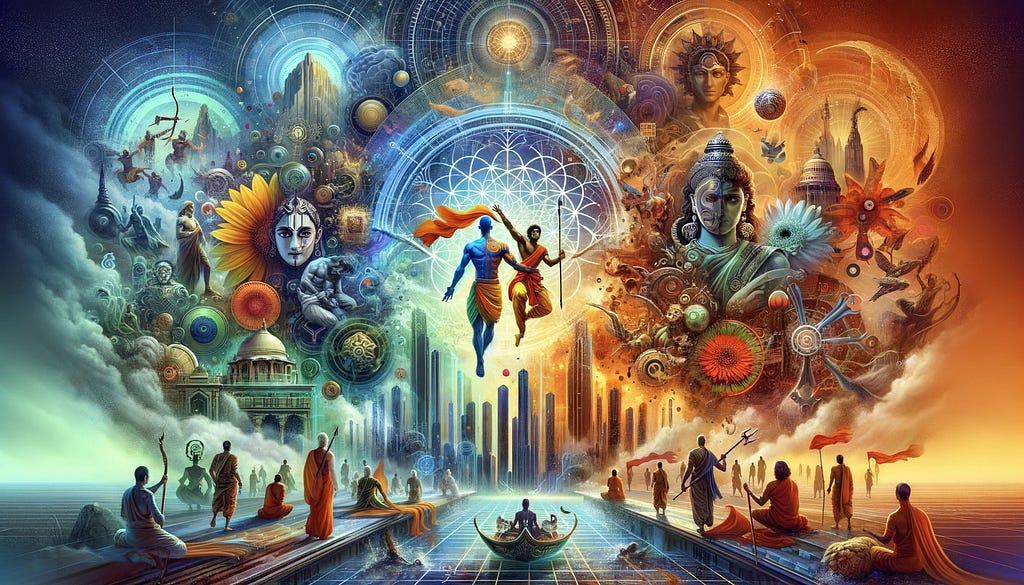
In the ancient parable of the Bhagavad Gita, a sacred text of wisdom, we encounter Arjuna, a warrior caught in a moral dilemma on the battlefield of Kurukshetra. Facing the prospect of fighting his own kin, Arjuna is paralyzed by doubt and despair. It is here that Krishna, his charioteer and guide, imparts to him profound insights on duty, righteousness, and the nature of the self. Krishna’s counsel illuminates the path of selfless action and the importance of fulfilling one’s role in the world with dedication, without attachment to the outcomes. This timeless wisdom exemplifies the new definition of heroism: engaging in the world with compassion and integrity, driven by a higher purpose beyond the self.
As we navigate the dawn of Artificial General Intelligence (AGI), humanity is poised at the cusp of a collective hero’s journey—a transformative quest that demands we redefine heroism in the context of our evolving consciousness and technological landscape. This pivotal era invites us to transcend traditional narratives of heroism, embracing instead a vision that reflects our interconnectedness and collective potential.
A New Paradigm of Heroism
Humanity’s path mirrors the hero’s journey, where the collective faces profound dilemmas and opportunities for growth. This journey is not just about overcoming external challenges but about evolving our collective consciousness, recognizing our interconnected role in the cosmos, and integrating AGI as a catalyst for positive change.
The concept of heroism has evolved through the ages, reflecting the values, struggles, and aspirations of humanity at different points in time. Today, as we face the dawn of a new era marked by technological marvels and existential questions, we find ourselves confronting a series of paradoxes that challenge traditional notions of heroism.
The essence of modern heroism is captured in the spiritual dialogue between Arjuna and Krishna, which highlights the shift from individual glory to collective well-being. Heroism today is about:
- Selfless Action: Engaging in actions that contribute to the greater good, embodying the principle of Nishkama Karma, or action without attachment to results.
- Wisdom in Leadership: Guiding others not through coercion but through inspiration and example, much like Krishna’s role as a mentor to Arjuna.
- Integration and Unity: Recognizing the unity of all existence and working towards harmony between humanity and nature, as well as between technological advancement and ethical considerations.
Embracing Paradoxes in Our Quest
Our search for a new hero navigates through paradoxes that challenge and deepen our understanding:
- The Warrior and the Peacemaker: True heroism involves the courage to fight for justice and the wisdom to seek peace, balancing assertiveness with compassion.
- The Known and the Unknown: Heroes are not only those celebrated in history but also the countless unknown individuals whose actions have silently shaped the course of humanity.
- Individual Growth and Collective Evolution: The hero’s journey is both a personal quest for enlightenment and a collective endeavor to elevate human consciousness.
AGI: A Companion on Our Journey
In this era of technological wonder, AGI emerges as a partner in our collective evolution, offering tools to solve complex challenges, enhance human potential, and deepen our understanding of the universe. Our relationship with AGI invites a reevaluation of heroism, emphasizing cooperation, ethical stewardship, and a shared vision for the future. As AGI emerges as a powerful force capable of reshaping our world, the definition of heroism must evolve to embrace both the individual and collective aspects of our journey.
The heroes of tomorrow are those who can navigate the paradoxes of our time, integrating the wisdom of the past with a vision for the future. They are the architects of a new consciousness, one that recognizes the interconnectedness of all life and the potential for technology to serve as a catalyst for growth and transformation.
Call to Action
How can we cultivate a new definition of heroism that embraces the complexities and paradoxes of the modern world?
In what ways can AGI support humanity’s collective hero’s journey towards a higher consciousness?
How can we ensure that the development and integration of AGI align with ethical principles that uplift humanity and foster a more compassionate, enlightened society?
As we stand on the brink of a new chapter in human history, the stories we tell about heroism have the power to shape our collective destiny. It is time to embrace a broader, more inclusive vision of heroism — one that honors the journey of every individual as part of humanity’s grand narrative of evolution and awakening.
Together, guided by new definitions of heroism and supported by the advancements of AGI, we can navigate the transformation dilemma and ascend towards a future filled with hope, unity, and boundless potential.
Raising humanity on a new path — it all start with You & AI I I…
Galorian
Redefining Heroism in the Age of AGI was originally published in Becoming Human: Artificial Intelligence Magazine on Medium, where people are continuing the conversation by highlighting and responding to this story.
5 Stoic Ideas for a Good Life
including Quotes to Live By

1. Dichotomy of Control
The dichotomy of control is about ‘controlling the controllables’.
Control what you can and leave the rest. Never give your ‘freedom to choose’ to anyone else.
“We cannot control the external events around us, but we can control our reactions to them.”
— Epictetus
Here’s one from Victor Frankl,
“Everything can be taken from a man but one thing . . . to choose one’s attitude in any given set of circumstances.”
— Victor Frankl, Man’s Search for Meaning
2. Rule of Life
Make it your life’s goal to ‘search for truth’.
“Seek ye first the good things of the mind,” Bacon admonishes us, “and the rest will either be supplied or its loss will not be felt.”
“Truth will not make us rich, but it will make us free.”
— Will Durant

3. Facing Anxiety
Don’t suffer from ‘Imagined Troubles’.
The one who suffers before it is necessary suffers twice.
Today I escaped anxiety. Or no, I discarded it, because it was within me, in my own perceptions — not outside.”
― Marcus Aurelius, Meditations
this one is from Seneca,
We suffer more in imagination than in reality
— Seneca
4. How to face Obstacles
According to the stoics, our obstacles give us the opportunity to practice the 4 stoic virtues of wisdom, courage, temperance or moderation, and justice in our daily lives.
Stoic believe in living a life in accordance with nature.
The impediment to action advances action, what stands in the way becomes the way.
— Marcus Aurelius
5. On Revenge
Give up the feeling of revenge because you’re going to inflict more pain to yourself.
The best form of revenge is to not be like them.
The best revenge is to be unlike him who performed the injustice.”
— Marcus Aurelius
Conclusion
The Stoics believed that the practice of virtue is enough to achieve ‘Eudaimonia’: a well-lived life.
The Stoic principles include living according to nature, controlling your perspective, managing expectations, negative visualization, re-framing, acceptance, and contemplating death.
By living according to these principles, you will stress less about things that don’t matter and live your life to the fullest.
5 Stoic Ideas for a Good Life was originally published in Becoming Human: Artificial Intelligence Magazine on Medium, where people are continuing the conversation by highlighting and responding to this story.
Transforming Imagery with AI: Exploring Generative Models and the Segment Anything Model (SAM)
Generative models have redefined what’s possible in computer vision, enabling innovations once only imaginable in science fiction. One breakthrough tool is the Segment Anything Model (SAM), which has dramatically simplified isolating subjects in images. In this blog, we’ll explore an application leveraging SAM and text-to-image diffusion models to give users unprecedented control over digital environments. Through SAM’s ability to manipulate imagery paired with diffusion models’ capacity to generate scenes from text, this app allows transforming images in groundbreaking ways.
Project Overview
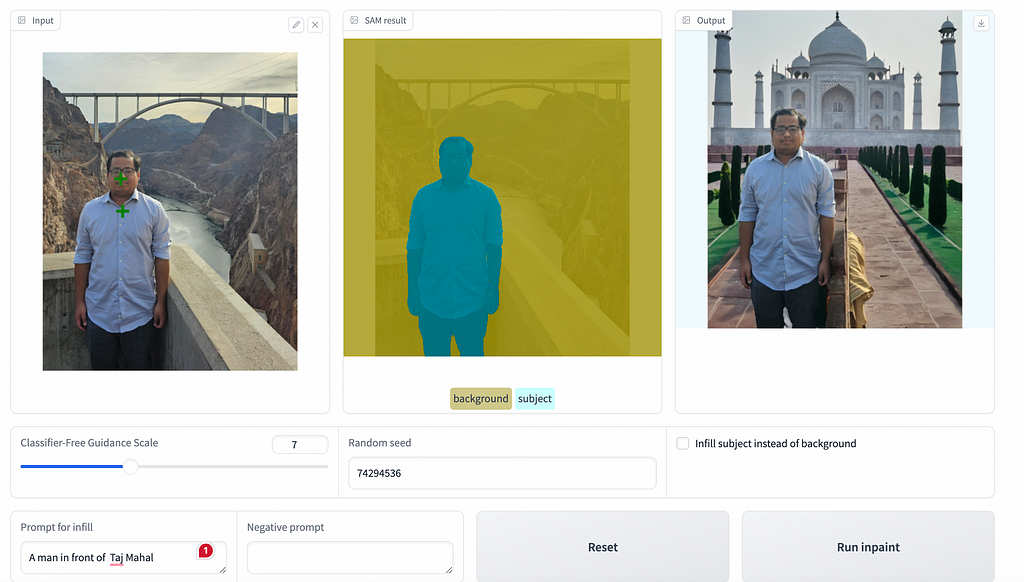
The goal is to build a web app that allows a user to upload an image, use SAM to create a segmentation mask highlighting the main subject, and then use Stable Diffusion inpainting to generate a new background based on a text prompt. The result is a seamlessly modified image that aligns with the user’s vision.
How It Works
- Image Upload and Subject Selection: Users start by uploading an image and selecting the main object they wish to isolate. This selection triggers SAM to generate a precise mask around the object.
- Mask Refinement: SAM’s initial mask can be refined by the user, adding or removing points to ensure accuracy. This interactive step ensures that the final mask perfectly captures the subject.
- Background or Subject Modification: Once the mask is finalized, users can specify a new background or a different subject through a text prompt. An infill model processes this prompt to generate the desired changes, integrating them into the original image to produce a new, modified version.
- Final Touches: Users have the option to further tweak the result, ensuring the modified image meets their expectations.
Implementation and Model
I used SAM (Segment Anything Model) from Meta to handle the segmentation. This model can create high-quality masks with just a couple of clicks to mark the object’s location.
Stable Diffusion uses diffusion models that add noise to real images over multiple steps until they become random noise. A neural network is then trained to remove the noise and recover the original images. By reversing this denoising process on random noise, the model can generate new realistic images matching patterns in the training data.
SAM (Segment Anything Model) generates masks of objects in an image without requiring large supervised datasets. With only a couple clicks to indicate the location of an object, it can accurately separate the “subject” from the “background”, which is useful for compositing and manipulation tasks.
Stable Diffusion generates images from text prompts and inputs. The inpainting mode allows part of an image to be filled in or altered based on a text prompt.
Combining SAM with diffusion techniques, I set out to create an application that empowers users to reimagine their photos, whether by swapping backgrounds, changing subjects, or creatively altering image compositions.
Loading the model and processing the images


Here, we import the necessary libraries and load the SAM model.
Image Segmentation with SAM (Segment Anaything Model)
Using SAM, we segment the selected subject from the image.

Inpainting with Diffusion Models
I utilize the inpainting model to alter the background or subject based on user prompts.


The inpainting model takes three key inputs: the original image, the mask-defining areas to edit, and the user’s textual prompt. The magic happens in how the model can understand and artistically interpret these prompts to generate new image elements that blend seamlessly with the untouched parts of the photo.
Interactive app
To allow easy use of the powerful Stable Diffusion model for image generation, an interactive web application using Gradio can be built. Gradio is an open-source Python library that enables quickly converting machine learning models into demos and apps, perfect for deploying AI like Stable Diffusion.
Results
The backgrounds were surprisingly coherent and realistic, thanks to Stable Diffusion’s strong image generation capabilities. There’s definitely room to improve the segmentation and blending, but overall, it worked well.
Future steps to explore
They are improving image and video quality while converting from text to image. Many startups are working on improving the video quality after prompting the text for various use cases.
Transforming Imagery with AI: Exploring Generative Models and the Segment Anything Model (SAM) was originally published in Becoming Human: Artificial Intelligence Magazine on Medium, where people are continuing the conversation by highlighting and responding to this story.
Zero Homes App Makes Heat Pumps, EV Chargers Etc Effortless, Affordable
Everything you Need to Know About Paid Search Management
Microsoft Introduces AI-Powered Copilot Features to Enhance Microsoft 365
Evolution of Supply Chain Management Through Big Data Implementation
REGRIP, Pioneer in Reengineered Tyres, Raises $2M Funding from SiriusOne Capital
How Beliefs & Ideology Shape your World

Beliefs & Ideology are our Operating System
Continue reading on Becoming Human: Artificial Intelligence Magazine »
AI is… about FINDING ANSWERS in the DATA.
We all collect data. So do all industries. But what’s the first step in planning the AI transformation? Finding a scenario where AI could help.
I’ve been writing about AI for quite some time now. Through numerous webinars and discussions, I’ve come to a conclusion: perhaps I’ve been focusing too much on the implementation and deployment of AI. During these conversations, it became evident that many industry leaders face a common challenge — they struggle to identify a starting point for integrating AI into their operations.
The more I engage with industry professionals, the more I understand the critical importance of addressing the fundamental question: Where does one begin the journey towards AI integration?
Before AI can even grace the agenda of workshops or meetings, organizations grapple with the daunting task of pinpointing how and where AI can be leveraged to drive meaningful impact. It’s not merely about deploying AI; it’s about finding the right scenario, the pivotal moment where AI can unravel insights and catalyze transformation.
This blog post will focus on just that: a list of a few pathways you can consider while jogging, swimming, surfing, or engaging in any activity before you jump into your car and head to meet your teams.
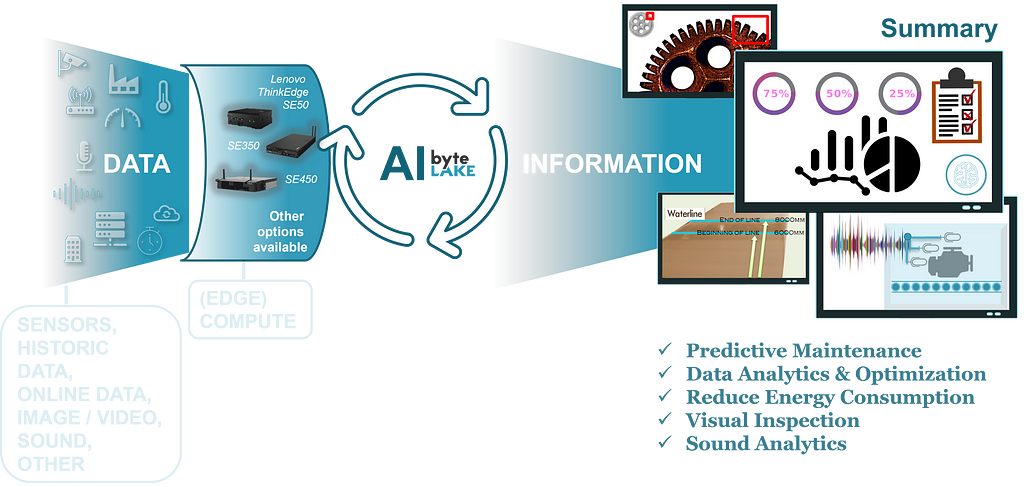
So what’s AI? While there are many definitions, we at byteLAKE say that AI is about transforming DATA into ACTIONABLE INSIGHTS.
And now, where could be your starting point for AI
If you happen to work in manufacturing, consider these scenarios:
- Automated visual inspection of products, parts, and components: cameras can help you automate quality inspections, detecting scratches, dents, paint chips, etc. AI can analyze images of your products and validate colors, prints, labels, etc.
- IoT sensors data analytics typically leads to implementing scenarios like predictive maintenance for better insights into processes, lowering the amount of unplanned downtimes, detecting risks earlier, etc.
- General data analytics typically helps find optimal setups or configurations to reduce energy consumption, identify reasons for incidents, etc.
In logistics, AI is typically used to automate counting, ensuring the quality of shipments, etc. A common phrase I have been hearing in that sector is along the lines of: if we ship too many products, hardly ever someone informs us about that. But, if we forget to send anything, we always get complaints which impact our reputation. Therefore, if working in logistics, think of scenarios where:
- Cameras can help you count products, analyze what you put into containers and, for instance, trigger an alarm if the wrong barcode or an expired product is detected.
- AI can count boxes, automate inventory processes, and, very much like in manufacturing, monitor overall quality: checking labels, validating documents, inspecting packaging, etc.
I need to explicitly mention the paper industry as we have been delivering AI solutions there for many years now. I assume that not many of my readers know, but AI can visually inspect the whole process and, for instance, detect quality issues in the paper sheets, boxes (i.e., missing prints, wrong labels), or monitor the papermaking process by measuring and analyzing the so-called wet line, aka waterline.
The automotive industry, another exciting sector with huge potential for AI, has seen significant progress. Most of the already mentioned aspects would apply there as well. Besides visual inspections and data analytics, sound analytics is embraced on assembly lines. AI can, for instance, analyze the sound produced by car engines or various car components like pumps, bearings, etc., and detect nuances that can identify faults or errors.
Let me finish this blog post by mentioning the energy sector where AI can, for instance, help you analyze all the data generated by various sensors attached across your infrastructure and suggest, for instance, optimal settings to minimize downtimes, reduce overall energy consumption, or improve reliability and client satisfaction.
can help you find answers within the vast expanse of data, enabling data-driven decisions. It can take into account readings from IoT sensors as well as your teams by analyzing their inputs, combining all of these with online data like weather forecasts, regulations, etc., and taking actions to minimize risks, identify issues, and suggest optimizations.
And I could continue listing other examples as basically EVERY industry has areas where AI can easily automate or optimize various operations. And of course, AI is not just a camera or intelligent sensor. It typically builds up into a robotic arm or a software system that either moves things around and AI becomes just a set of workers focused on certain things like:
- AI-robot #1 performs visual inspection
- AI-robot #2 performs data analytics
- …
- AI-robot #n consolidates all of these and turns everything into information: SET parameters X, Y, Z to A, B, C, respectively to reduce energy consumption by 30%, avoid downtimes and send maintenance teams to area #41 and #51.
Although there are other areas where AI can help like, for instance, the back office of all mentioned industries (document processing, boring office task automation, etc.), I hope this blog post will still help at least some of you identify the first one or yet another area where to start your next AI journey. Have a great weekend!
https://medium.com/media/20f6637885c3f261f9c27f3a9f60951b/href
AI is… about FINDING ANSWERS in the DATA. was originally published in Becoming Human: Artificial Intelligence Magazine on Medium, where people are continuing the conversation by highlighting and responding to this story.