REGRIP, Pioneer in Reengineered Tyres, Raises $2M Funding from SiriusOne Capital
How Beliefs & Ideology Shape your World

Beliefs & Ideology are our Operating System
Continue reading on Becoming Human: Artificial Intelligence Magazine »
AI is… about FINDING ANSWERS in the DATA.
We all collect data. So do all industries. But what’s the first step in planning the AI transformation? Finding a scenario where AI could help.
I’ve been writing about AI for quite some time now. Through numerous webinars and discussions, I’ve come to a conclusion: perhaps I’ve been focusing too much on the implementation and deployment of AI. During these conversations, it became evident that many industry leaders face a common challenge — they struggle to identify a starting point for integrating AI into their operations.
The more I engage with industry professionals, the more I understand the critical importance of addressing the fundamental question: Where does one begin the journey towards AI integration?
Before AI can even grace the agenda of workshops or meetings, organizations grapple with the daunting task of pinpointing how and where AI can be leveraged to drive meaningful impact. It’s not merely about deploying AI; it’s about finding the right scenario, the pivotal moment where AI can unravel insights and catalyze transformation.
This blog post will focus on just that: a list of a few pathways you can consider while jogging, swimming, surfing, or engaging in any activity before you jump into your car and head to meet your teams.
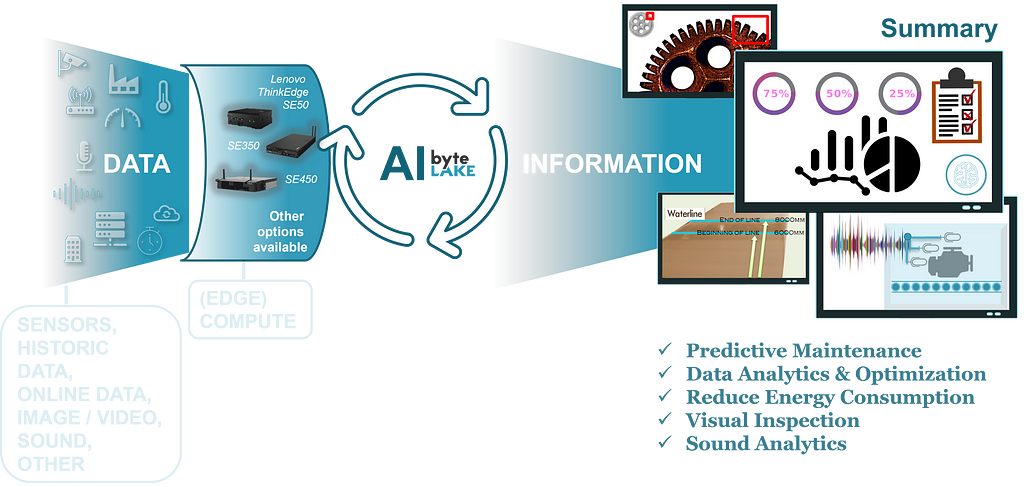
So what’s AI? While there are many definitions, we at byteLAKE say that AI is about transforming DATA into ACTIONABLE INSIGHTS.
And now, where could be your starting point for AI
If you happen to work in manufacturing, consider these scenarios:
- Automated visual inspection of products, parts, and components: cameras can help you automate quality inspections, detecting scratches, dents, paint chips, etc. AI can analyze images of your products and validate colors, prints, labels, etc.
- IoT sensors data analytics typically leads to implementing scenarios like predictive maintenance for better insights into processes, lowering the amount of unplanned downtimes, detecting risks earlier, etc.
- General data analytics typically helps find optimal setups or configurations to reduce energy consumption, identify reasons for incidents, etc.
In logistics, AI is typically used to automate counting, ensuring the quality of shipments, etc. A common phrase I have been hearing in that sector is along the lines of: if we ship too many products, hardly ever someone informs us about that. But, if we forget to send anything, we always get complaints which impact our reputation. Therefore, if working in logistics, think of scenarios where:
- Cameras can help you count products, analyze what you put into containers and, for instance, trigger an alarm if the wrong barcode or an expired product is detected.
- AI can count boxes, automate inventory processes, and, very much like in manufacturing, monitor overall quality: checking labels, validating documents, inspecting packaging, etc.
I need to explicitly mention the paper industry as we have been delivering AI solutions there for many years now. I assume that not many of my readers know, but AI can visually inspect the whole process and, for instance, detect quality issues in the paper sheets, boxes (i.e., missing prints, wrong labels), or monitor the papermaking process by measuring and analyzing the so-called wet line, aka waterline.
The automotive industry, another exciting sector with huge potential for AI, has seen significant progress. Most of the already mentioned aspects would apply there as well. Besides visual inspections and data analytics, sound analytics is embraced on assembly lines. AI can, for instance, analyze the sound produced by car engines or various car components like pumps, bearings, etc., and detect nuances that can identify faults or errors.
Let me finish this blog post by mentioning the energy sector where AI can, for instance, help you analyze all the data generated by various sensors attached across your infrastructure and suggest, for instance, optimal settings to minimize downtimes, reduce overall energy consumption, or improve reliability and client satisfaction.
can help you find answers within the vast expanse of data, enabling data-driven decisions. It can take into account readings from IoT sensors as well as your teams by analyzing their inputs, combining all of these with online data like weather forecasts, regulations, etc., and taking actions to minimize risks, identify issues, and suggest optimizations.
And I could continue listing other examples as basically EVERY industry has areas where AI can easily automate or optimize various operations. And of course, AI is not just a camera or intelligent sensor. It typically builds up into a robotic arm or a software system that either moves things around and AI becomes just a set of workers focused on certain things like:
- AI-robot #1 performs visual inspection
- AI-robot #2 performs data analytics
- …
- AI-robot #n consolidates all of these and turns everything into information: SET parameters X, Y, Z to A, B, C, respectively to reduce energy consumption by 30%, avoid downtimes and send maintenance teams to area #41 and #51.
Although there are other areas where AI can help like, for instance, the back office of all mentioned industries (document processing, boring office task automation, etc.), I hope this blog post will still help at least some of you identify the first one or yet another area where to start your next AI journey. Have a great weekend!
https://medium.com/media/20f6637885c3f261f9c27f3a9f60951b/href
AI is… about FINDING ANSWERS in the DATA. was originally published in Becoming Human: Artificial Intelligence Magazine on Medium, where people are continuing the conversation by highlighting and responding to this story.
Nowruz Wisdom: Learning from the Haft-Seen for a Tech-Forward Future

Happy Nowruz. As we usher in the spring season, let’s embrace the wisdom of the traditional Haft-Seen table.
Celebrated by around 300 million people globally, including many across the United States, Nowruz marks the first day of Spring and the New Year. The Haft-Seen, with its seven symbolic items each beginning with the letter ‘S’ in Persian, offers lessons for our journey through the new digital age:
- Sabzeh (Sprouts) — Just as sprouts signify new beginnings, AI represents a new era of growth and innovation. We’re reminded to embrace change and the fresh perspectives it brings.
- Sumac (Spice of Life) — Sumac, with its vibrant color and flavor, symbolizes the diversity and richness of life. It’s a call to ensure that AI adds value and diversity to our existence, not just efficiency.
- Samanu (Sweet Pudding) — The intricate process of making Samanu reflects the complexity behind AI technologies. It teaches us that patience and careful cultivation can lead to rewarding outcomes.
- Senjed (Dried Oleaster Fruit) — Senjed symbolizes love, reminding us to maintain humanity and empathy in a world increasingly run by algorithms. Ensuring AI enhances human connections is crucial.
- Seer (Garlic) — Garlic, known for its medicinal properties, can be likened to the role of AI in healthcare—offering the potential for healing and fostering well-being.
- Seeb (Apple) — The apple represents beauty, reminding us that in our pursuit of technological advancement, we should also appreciate and cultivate the aesthetic and creative aspects of life.
- Serkeh (Vinegar) — Vinegar symbolizes age and patience. It teaches us that while technology moves fast, patience and persistence are vital in ensuring sustainable and thoughtful progress.

In addition to the seven “S” items of the Haft-Seen, the Nowruz table often includes a mirror, a book of poetry, candles, a goldfish in a bowl, hyacinth, sweets, and coins, each gaining new significance as I get older. The mirror encourages introspection in a digital world, reflecting our values against the backdrop of technology.
Poetry preserves the essence of emotion and art. Candles symbolize the human spirit’s resilience against technological domination. The goldfish, in its fluid grace, reminds us of life’s vitality within structured environments. Hyacinths represent the integration of nature with technology, emphasizing growth and renewal.
Sweets remind us to savor life’s joys and connections beyond digital interactions. Lastly, coins point to new economic dynamics that await us.
As my family and I celebrate the Nowruz season, these reflections from the Haft-Seen table inspire me to meet the future with a blend of tradition and innovation. Wishing everyone a Nowruz filled with growth, health, and joyful discovery.
This content was crafted with the assistance of artificial intelligence, which contributed to structuring the narrative, ensuring grammatical accuracy, and summarizing key points to enhance the readability and coherence of the material.
Nowruz Wisdom: Learning from the Haft-Seen for a Tech-Forward Future was originally published in Becoming Human: Artificial Intelligence Magazine on Medium, where people are continuing the conversation by highlighting and responding to this story.
Qila.io collaborates with Mascot to bring transparency in Research
Cybersecurity startup Treacle raises INR 4 Crores in pre-seed
Smart Meetings solution leverages AI Technology – Reclaim AI
AI Startup Myelin Foundry Secures $4M Investment for Global Edge AI Push
4 Ways AI Can Help Boost Your Restaurant Business
LiDAR Annotation: Boosting AI’s Perception Capabilities
LiDAR or light detection and ranging can be described as a remote sensing technology that utilizes lasers to measure distances. It is used for producing accurate three-dimensional information with regard to shape and features of surrounding objects. It is also useful in scenarios requiring high-precision and high-resolution information regarding shape and location of objects.
Modern LiDAR systems are capable of transmitting up to hundred thousand pulses in a second. The measurements that originate from these pulses are gathered into a point cloud. A point cloud is a group of coordinates representing objects sensed by the system. It is used for creating a 3D model of space around the LiDAR.
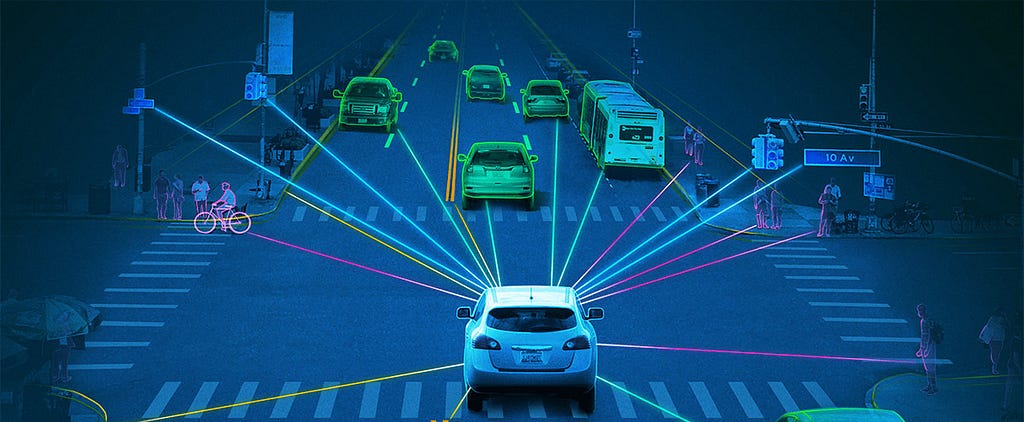
LiDAR systems are a combination of four elements; laser, scanner, sensor, and GPS. Let’s discuss each one below.
- Laser: Transmits light pulses (ultraviolet or infrared) on objects.
2. Scanner: Adjusts the speed of the laser in scanning and targeting objects, along with the ultimate distance reached by the laser.
3. Sensor: Traps the light pulses emitted on their return as they are reflected from the surfaces. The measure of the total travel time of a reflected light pulse enables the system to estimate the distance of the surface.
4. GPS: It is used for tracking the location of the LiDAR system to ensure the distance measurements are accurate.

Significance of LiDAR Annotation
LiDAR annotation is used for making detailed 3D maps to boost the perception capabilities in many systems. Deep learning tasks on LiDAR data are variables of semantic segmentation, object detection and classification. Hence, annotation of LiDAR data is quite similar to image annotation for the same tasks. With respect to object detection, a 3D bounding box is placed in place of a 2D one for images. For semantic segmentation, a single label is needed for each point in the point cloud as a single label is required for each pixel in an image.
Types of LiDAR Systems
LiDAR systems are of two types — airborne and terrestrial. Airborne is self-explanatory, however, terrestrial LiDAR is concerned with objects on the ground and scans in all directions. The objects could be static, i.e fixed to a tripod or building or mobile, i.e. fixed to a car or train.
Let’s take the use case of autonomous vehicles and understand how LiDAR annotation helps in navigating vehicles on the road to prevent accidents and comply with traffic rules. The LiDAR sensor acquires data from several thousand laser pulses each second. An onboard computer is used for analysing the ‘point cloud’ of laser reflection points for animating a 3D representation of its environment. Ensuring the accuracy of LiDAR in creating a 3D representation of its environment involves training the AI model with annotated point cloud datasets.
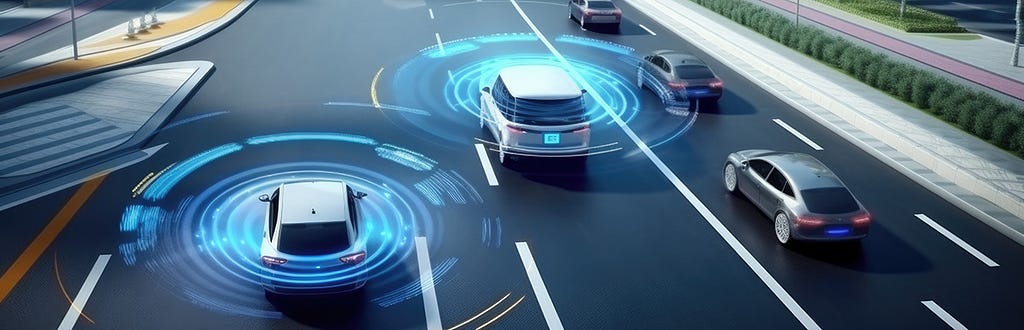
The annotated data permits autonomous vehicles in detecting, identifying and classifying objects. This assists in precise detection of road lanes, moving objects, and real-world traffic situations by autonomous vehicles. Car makers have already begun integrating LiDAR technology in advanced driver assistance systems (ADAS) for making sense of the dynamic traffic environment surrounding the vehicle. These systems enable accurate split-second decisions as per hundreds of careful calculations derived from hundreds of thousands of data points to ensure the self-driving car’s journey is safe and secure.
Summary
Hence, LiDAR annotation plays a critical role in perception enhancement of autonomous systems. Through precision labeling of LiDAR point cloud data, autonomous vehicles, drones, etc can acquire a better understanding of their surroundings, detecting objects and making informed decisions. LiDAR annotation as a process requires assignment of labels for individual points, drawing bounding boxes, or performing semantic and instance segmentation. But it also poses challenges like complexity, ambiguity and labeling consistency. Adherence to industry best practices, using specialized tools and adopting future trends will enhance the efficacy of LiDAR annotation leading to advancement of autonomous systems.
LiDAR Annotation: Boosting AI’s Perception Capabilities was originally published in Becoming Human: Artificial Intelligence Magazine on Medium, where people are continuing the conversation by highlighting and responding to this story.